|
||||||||||||||||
|















|
|
|
|
|||||
 |
||||||||
|
The Salamanders and the Pyre Wardens The Salamanders, XVIII Legion of the Legiones Astartes, are defined as much by their mastery of the forge as by their conduct in war. Forged in the harsh volcanic crucibles of Nocturne and guided by the will of their Primarch, Vulkan, they embody resilience, craftsmanship, and a measured application of destructive force. To the Salamanders, war is not an act of wanton annihilation, but a discipline—each weapon a tool, each strike a deliberate act.
The Pyre Wardens are a specialised sub-sect of the Legion’s forge tradition, operating at the intersection of innovation and battlefield necessity. Tasked with the development, testing, and refinement of advanced wargear under live combat conditions, they serve as both artificers and evaluators of experimental designs. Their cadres are frequently deployed alongside frontline forces, where prototype weapons and armour patterns are subjected to the ultimate trial: war itself. Though their work carries inherent risks - unstable systems, unproven configurations, and the ever-present danger of catastrophic failure—the contributions of the Pyre Wardens have echoed across the Legion. Many of the Salamanders’ most distinctive wargear patterns trace their origins to these trials by fire. In the hands of the Pyre Wardens, the forge is never still. It burns, adapts, and evolves—just as the Salamanders themselves.
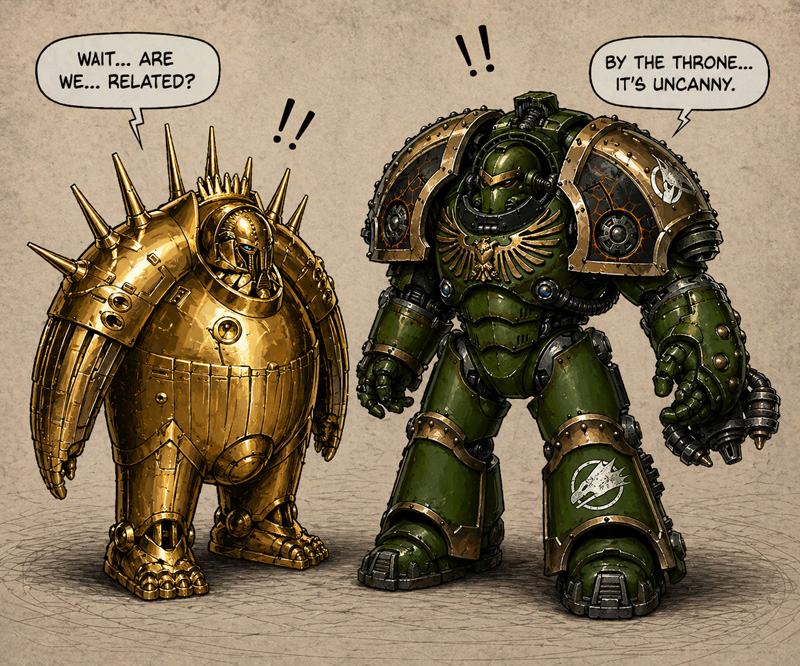
I’ve always liked the idea behind the Saturnine Terminators. They feel ancient, brutal, and completely over-engineered in a very “Horus Heresy” way. At the same time, though, something about the design never quite worked for me. The massive domed shoulder plates are iconic, but they also push the silhouette into a direction that feels… a bit too bulky and almost unintentionally goofy. At one point I realized they actually reminded me of the Mondoshawan from The Fifth Element—which I couldn’t unsee after that.
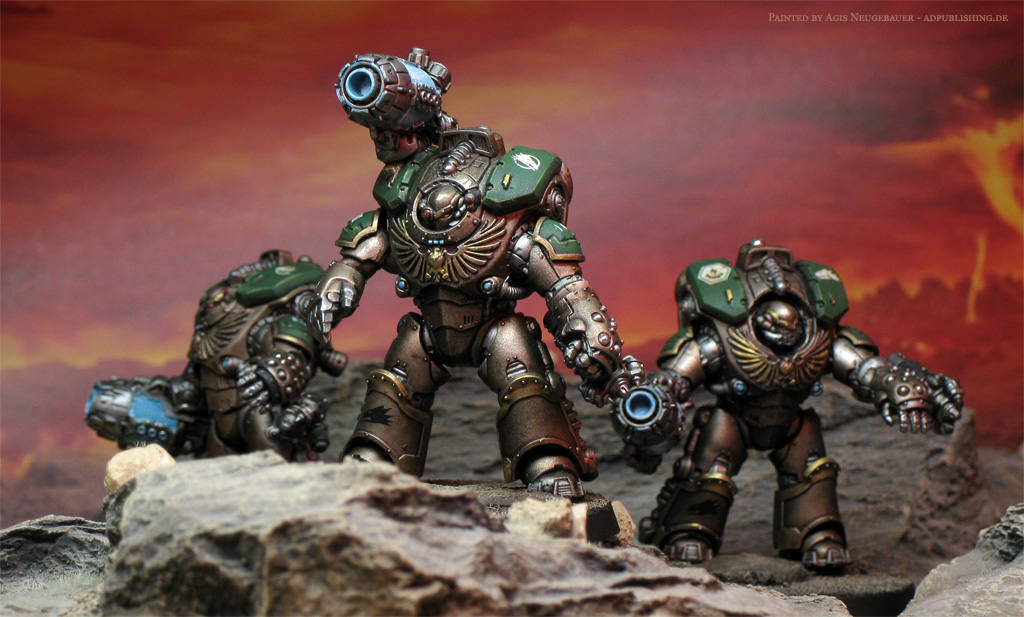
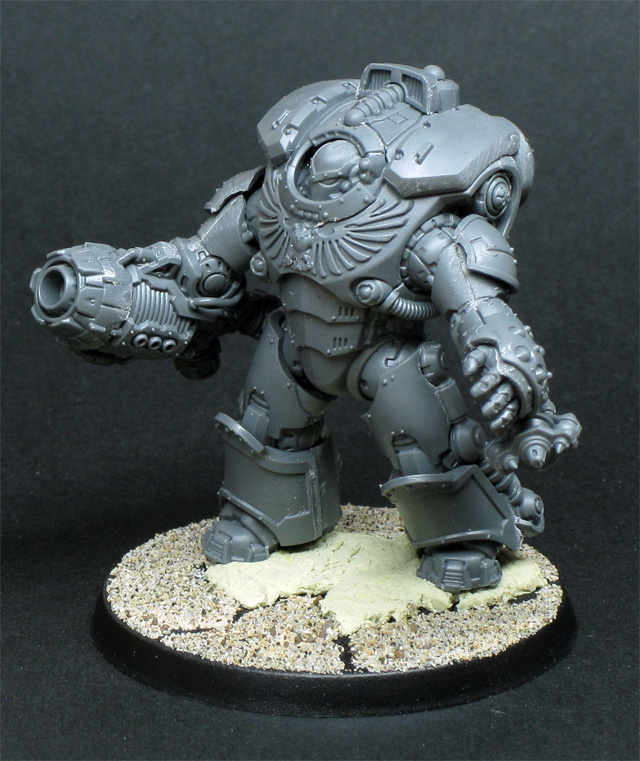
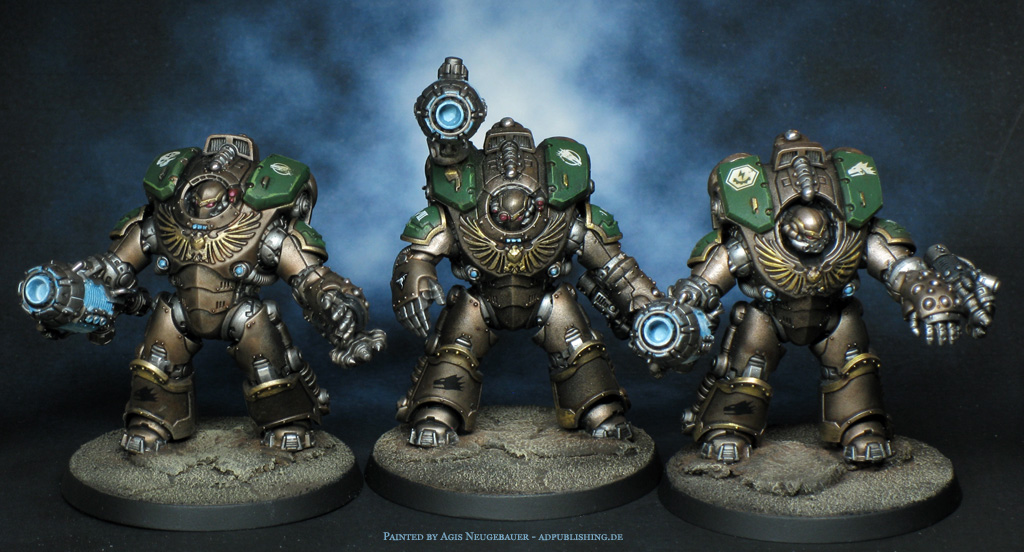
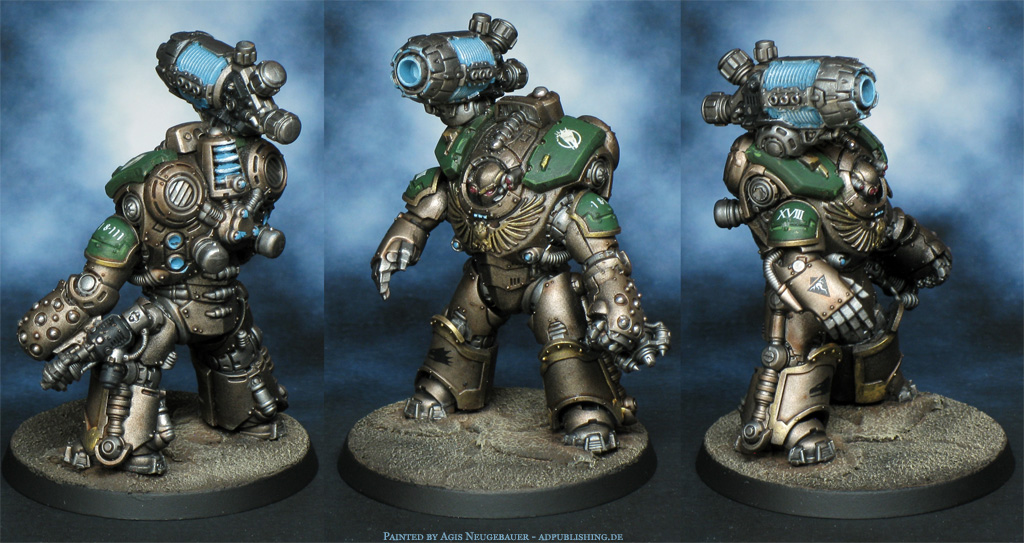
Still, I liked the core concept enough to start building a few models anyway. During assembly, I left the shoulder domes off temporarily—and that’s when it clicked. Without them, the whole model changed. The proportions felt more grounded, the silhouette more aggressive and readable. It still had all the weight and presence of a Saturnine suit, but looked less like a walking relic and more like an actual war machine.
At that point the idea really started to take shape. I didn’t just want it to be a visual tweak—I wanted a reason for it to exist. That’s when I came across the Pyre Wardens in Journal Tactica: The Forges of Saturn. The idea of a Salamanders sub-group focused on experimental wargear fit perfectly. From there, everything came together quite naturally:
So the Ashfall Saturnine Cadre basically grew out of a simple observation during building:
PYRE WARDENS – ASHFALL SATURNINE CADRE Among the most esoteric design proposals to emerge from the Pyre Wardens were the so-called Ashfall Saturnine Cadres - a radical reimagining of Saturnine-pattern Terminator armour, conceived not as immovable bulwarks, but as instruments of precise and devastating annihilation. Where orthodox Saturnine war-plate embodies resilience and immutability, the Ashfall pattern was envisioned as a deliberate departure from these principles. Central to the design was the complete removal of the immense, domed shoulder carapaces that define the pattern. In their place, reduced plating, exposed servo-bundles, and layered heat-dissipation structures were proposed, creating a silhouette that retained a broad, reinforced torso while allowing for greater articulation and responsiveness in the upper limbs. This controversial configuration served a singular purpose: the efficient management of extreme plasma discharge. Reinforced internal heat sinks and experimental thermal regulators were to be integrated throughout the armour, compensating for the removal of traditional bulk plating by allowing excess thermal energy to be vented rapidly rather than contained. In conjunction with this, a volatile servo-overdrive system was incorporated into the design, enabling short bursts of enhanced mobility - an unprecedented capability for Saturnine-equipped warriors. In projected battlefield application, such units would have presented a disquieting spectacle: towering engines of war capable of delivering overwhelming plasma bombardment before rapidly displacing, denying the enemy effective retaliation. The intended primary armament of the Ashfall Cadres was the Plasma Bombardment Array, conceived as a shoulder- or back-mounted system capable of indirect, high-yield plasma strikes. Unlike conventional Legion plasma weapons, this array was designed for singular, catastrophic salvos rather than sustained fire, delivering overcharged munitions with delayed or area-effect detonation. However, it is recorded that the few prototypes deployed during the Dropsite Massacre on Isstvan V did not yet incorporate this system, instead utilising standard arm-mounted plasma bombardments in keeping with existing Saturnine configurations. For close-quarters engagement, the design specified the Disruption Fist, an advanced evolution of the power fist incorporating destabilisation fields. These weapons were intended to compromise energy barriers and induce catastrophic structural failure in armour at the molecular level, favouring precision annihilation over brute force alone. Doctrinally, the Ashfall Cadres were conceived to operate in stark contrast to established Terminator deployment patterns. Rather than forming static lines or advancing as implacable spearheads, they were to function as mobile fire support elements - deploying beyond direct lines of sight, guided by forward reconnaissance assets, and executing a strict cycle of bombardment and displacement. This operational method, later summarised as “strike, scorch, vanish,” aimed to minimise exposure to counter-fire while maximising disruption of enemy formations. The conceptual origin of the Ashfall pattern lay in a critique long held within the Pyre Wardens: that Saturnine armour, while peerless in durability, was overly ponderous and tactically predictable. In response, the design sought to advance an unfulfilled line of thought attributed to Vulkan - to temper strength with adaptability, and to refine destruction into a controlled and deliberate instrument. Despite its promise, the design was met with considerable opposition within the Legion Forge. Concerns regarding structural compromise, plasma overload, and projected attrition rates led many to deem the concept dangerously unstable. With the outbreak of the Isstvan betrayal, Vulkan ordered all further development was abandoned, the project deemed untenable amidst the Legion’s catastrophic losses. Only a limited number of prototypes - no more than three suits - have seen active deployment in this configuration, all utilising standard arm-mounted plasma systems. That any survived the fires of Isstvan remains a matter of fragmented record and apocryphal account. The full Ashfall pattern, including dorsal bombardment arrays, remained unrealised.
Within the hidden archives of the Pyre Wardens, the Ashfall Saturnine Cadre endures not as a failure, but as an unfinished design - its true potential forever lost to the flames of treachery. The design stands as a testament to the Pyre Wardens’ willingness to challenge orthodoxy and to walk the narrow line between mastery of the forge and destruction within it.
Disclaimer All photographs featured on this website are © Agis Neugebauer. Personal Note on AI Usage The use of AI tools in this project has been a highly engaging and creativity-enhancing experience for me, opening up new ways to explore my ideas, concepts, and visual design.
|
||||||||